
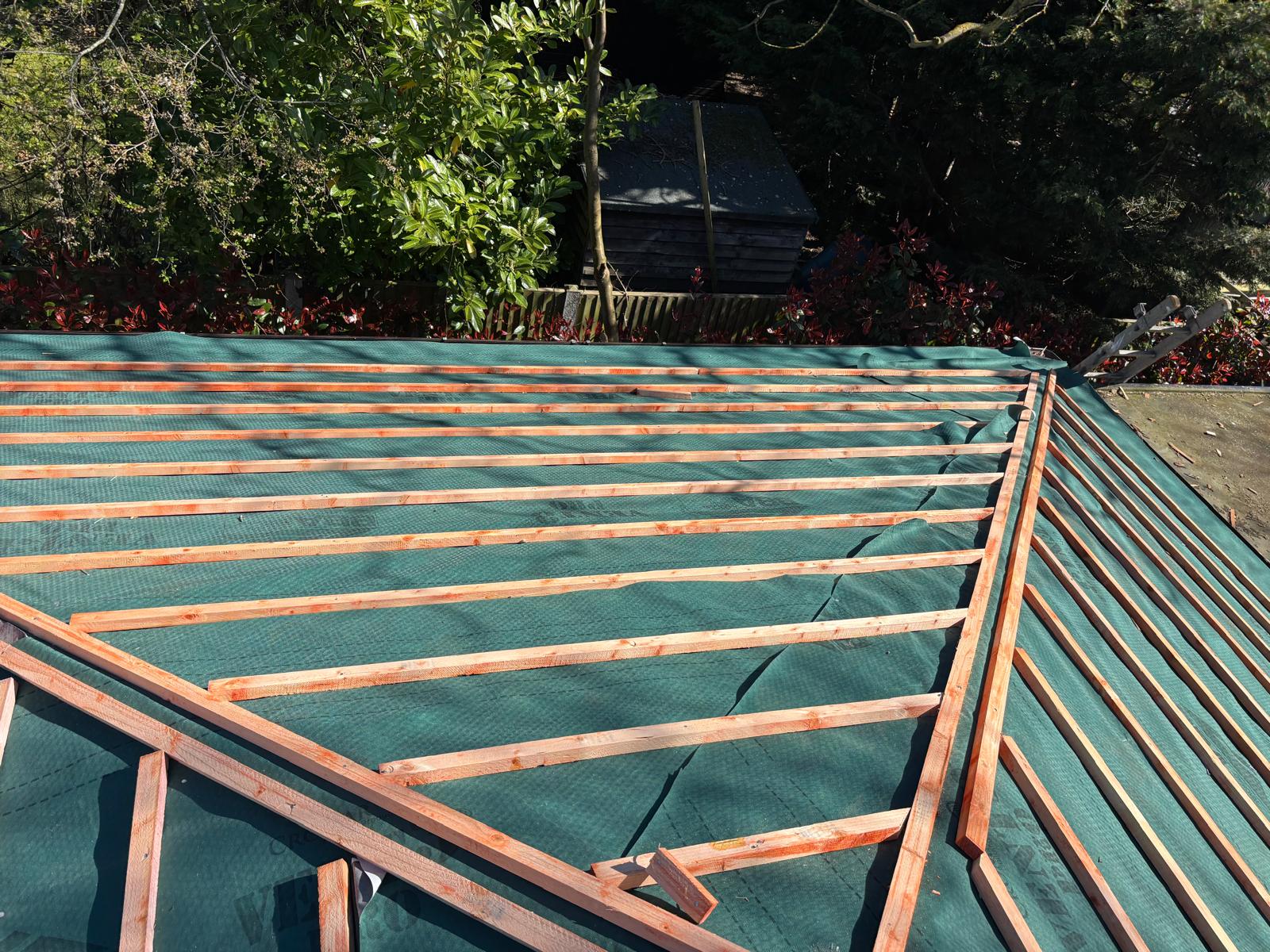
Gutter and roof health are connected because of what happens when a gutter stops working, and it is rarely what homeowners expect. Most people assume a blocked gutter simply overflows down the outside wall, which looks untidy but sounds harmless. What actually happens first is that water backs up at the eaves and finds its way behind the gutter, onto the fascia, onto the ends of the rafters and into the roof structure. The eaves is the single most vulnerable part of a pitched roof, because it is the point where the underlay stops and where the roof timbers meet the wall.
So gutter maintenance is not cosmetic, and in truth it is not really about the gutter. It is about protecting the most expensive thing on the roof to put right, which is the structural timber sitting a few centimetres behind that gutter. Clearing a gutter is a small job. Replacing rotted rafter ends means stripping back the bottom courses of tiles, cutting out and splicing in new timber, and reinstating the roof covering above it. We have found that this exact sequence, running from a neglected gutter to a timber repair, is behind a large share of the avoidable damage we are called out to assess.
At Hythe and Folkestone Roofers we have completed more than 400 roof replacement projects across Kent over the past ten years. On the older properties within that number, damage caused by guttering is one of the most common hidden problems we uncover once the bottom courses come off, and it is almost never the reason the client called us in the first place.
The Eaves Is Where Roofs Quietly Fail
The eaves is the bottom edge of the roof where the tiles overhang and shed water into the gutter. For that to work properly, the underlay beneath the tiles has to carry any water that gets past the covering out past the fascia and drop it into the gutter. On a correctly built modern roof there is an eaves protection tray, a rigid plastic tray fitted over the fascia that supports the underlay and holds it in the right shape so the water lands where it should.
A great deal of the older housing stock across Hythe, Folkestone and Ashford has no eaves tray at all. The original bitumen felt was cut off at the fascia line or simply draped over it, and after several decades that felt has sagged, split or curled back on itself. Once the felt has pulled back behind the fascia, water that gets past the tiles is delivered onto bare timber rather than into the gutter, and nobody sees it happen.
Add a blocked gutter to that and the problem compounds. The water level rises above the drip line of the tiles, so the roof can no longer discharge cleanly, and water tracks back along the underside of the tile onto the fascia instead. If the gutter has also tipped backwards on failing brackets, it pours directly onto the timber. This is why two roofs of the same age in the same street can be in completely different condition. The one with clear gutters is fine. The one that has been overflowing for six winters is not.
What a Blocked Gutter Actually Damages
The fascia and soffit go first. On a painted timber fascia this is visible from the ground as flaking paint and a soft, darkened board. On PVCu it is far more dangerous, because a lot of PVCu fascia in Kent was capped over the original timber rather than replacing it. The plastic looks perfect for years while the board behind it stays wet permanently.
The rafter feet follow. These are the ends of the rafters where they bear onto the wall plate, and they are structural. Rot here is slow, invisible and expensive, and it is why we always want eyes on the eaves rather than just the main roof slope.
Soffit damage also has a knock-on effect that surprises people. When rotten soffits get replaced, the ventilation gaps or vents that were there originally are frequently left out or covered over, and the loft loses the airflow it depends on. From working with clients on properties where damp appeared in the loft shortly after new fascias and soffits went on, the guttering was the original cause and the ventilation was collateral damage. If you are unsure whether your loft is breathing properly, the signs of poor roof ventilation are worth knowing before you accept that the problem is the roof covering.
Finally there is the wall. Overflowing gutters saturate masonry, and on the solid-wall Victorian and Edwardian properties common around Hythe and Folkestone seafront that means penetrating damp on the inside face, with no cavity to stop it.
Standing Water Is Not Always a Blockage
Here is a diagnostic that saves people money. If your gutter has been cleared and it still holds water, the problem is not debris. It is the fall.
Guttering needs a consistent slope towards the outlet, and it needs brackets at close enough centres to hold that line. Brackets at roughly one metre apart is the usual guidance, and closer than that in exposed positions. When brackets corrode, work loose, or were spaced too widely to begin with, the gutter sags into a shallow dip. That dip holds water, which then attracts silt and moss, which then blocks properly. Cleaning it out treats the symptom and you will be back doing it every few months.
In our experience, refixing a sagging gutter run to the correct fall works better than repeated cleaning because cleaning cannot change the geometry that is causing the blockage in the first place. A gutter that empties completely stays clear far longer than one that does not, and that is a one-off job rather than a recurring one.
What the Kent Coast Does to Guttering
Coastal exposure changes the maintenance picture. Salt-laden air attacks metal fixings, so on properties near the front we see gutter brackets, screws and cast iron sections corroding noticeably faster than they do a few miles inland. On period properties with original cast iron guttering the sections themselves are often perfectly serviceable while the fixings holding them up have given out entirely.
Wind is the other factor. Driven rain on an exposed elevation puts far more water through the gutter than the sheltered side of the same house, and gull activity along the Hythe and Folkestone coast adds nesting material that jams outlets rather than settling as silt. Moss is the third contributor, because it does not stay on the roof. It sheds gradually into the gutter and packs down into a dense mat at the outlet, and understanding how moss damages a roof over time explains why the gutters on a moss-covered roof block far faster than the neighbouring property.
A Word on Gutter Guards
Gutter guards and mesh covers are sold as a permanent fix, and we would be careful with that promise. In our experience, clearing gutters properly twice a year works better than fitting mesh guards because the guards trap moss granules and needles on top of the mesh where they are far harder to remove, turning a straightforward clearing job into a removal and refitting job. On a roof shedding moss, that trade rarely pays off. Guards can work on a clean tiled roof under deciduous trees, but they are not a substitute for looking at the gutter.
How to Check Your Gutters Without Getting on a Ladder
The most useful inspection of a gutter is done during heavy rain, from the ground, which almost nobody does. Standing back during a downpour tells you in two minutes exactly where the gutter is overflowing, whether water is running behind the fascia, and whether the downpipe is discharging properly at the bottom. A dry inspection cannot show you any of that.
Between rainfall, look for green algae streaking down the wall below a specific point, which marks a persistent overflow, and check the gully at the base of the downpipe, because a surprising number of gutter complaints turn out to be a blocked gully backing water up the pipe.
What you should not do is go up a ladder to find out. Falls from height are the leading cause of serious injury in this trade, the HSE guidance on work at height exists for good reason, and leaning a ladder against PVCu guttering is a reliable way to break the gutter you were trying to inspect.
Getting It Assessed Properly
Our approach pairs two things because neither is sufficient alone. A drone survey gives a close, safe view along the full gutter line, the outlets and the eaves detail, including the runs you cannot see from the ground or from a ladder. But a drone cannot see the underside of the eaves, so we also inspect from inside the loft, checking the felt at the eaves for tearing and pull-back, the rafter feet for staining and softness, and the wall plate where the timber meets the masonry.
That combination tells you whether you are looking at routine maintenance, a targeted repair to the eaves and fascia, or something that has progressed far enough to need wider building work. It also tells you honestly when the answer is that nothing needs doing beyond a clear-out, which is the answer more often than most homeowners assume. Storm damage does not wait for a convenient appointment, which is why we also run a 24 hour emergency callout across Kent.
If your gutters have been overflowing and you want to know whether the roof behind them has been affected, contact us and we will inspect it properly before recommending anything.