So, What Is the Difference Between Roof Repair and Restoration?
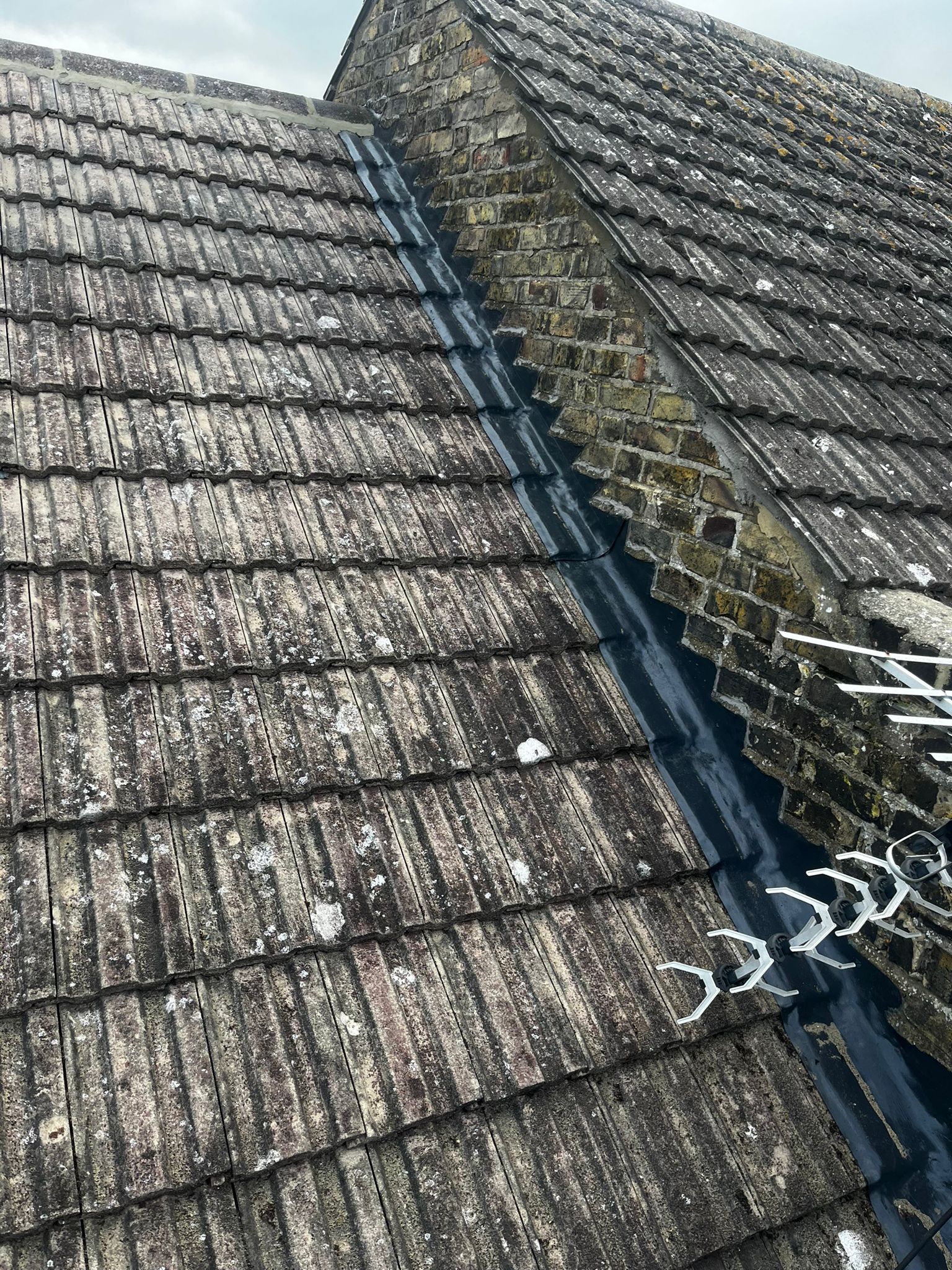
The difference between roof repair and restoration comes down to scope. A roof repair fixes an identified fault. Three slipped slates above a bedroom window, a failed lead flashing at the chimney, one cracked tile letting water onto the landing ceiling. A roof restoration treats the whole roof as a single job, which means replacing every defective tile across an elevation rather than only the ones that have already failed, refixing the ridge and hip tiles, renewing verges and flashings, stripping off moss, and putting the gutters and fittings back into working order.
Here is the part homeowners are rarely told. Both work only on what sits above the tiles. Neither renews the underlay or the battens beneath them. If the felt under your tiles has perished or the battens have rotted, no repair and no restoration will resolve it, because neither process ever gets that far down. Only a full strip and re-roof reaches the layers that actually keep water out of your loft. So the honest answer to which one you need depends far less on how the roof looks from the pavement and far more on what is happening a few centimetres underneath it.
At Hythe and Folkestone Roofers we have completed more than 400 roof replacement projects across Kent over the past ten years. A large share of the roofs we are called out to assess turn out not to need replacing at all, and separating those two groups accurately is most of the job. From working with clients across Hythe, Folkestone, Dover and Ashford, we have found that the people who make an expensive mistake here are almost always the ones who were sold work on the strength of a photograph of the roof surface rather than an inspection of the roof structure.
What a Roof Repair Actually Covers
A roof repair is reactive and localised. Something has failed, you can usually point at where, and the work addresses that specific defect. Typical repairs include replacing storm-damaged tiles, resealing or renewing a section of flashing, refixing slipped slates, repointing a short run of cracked ridge mortar, and sealing a failed joint on a flat roof section.
Repair is the correct choice when the roof is otherwise sound and well inside its expected service life, when the damage is traceable to a specific event such as a storm or a dislodged aerial, and when the underlay and battens are intact. In those circumstances a repair is not a compromise. It is simply the proportionate answer.
What a Roof Restoration Actually Covers
Restoration is planned rather than reactive. It assumes the roof structure is sound but the covering and its detailing have aged across the board. A proper restoration usually involves replacing all cracked, porous and slipped tiles rather than just the failed ones, removing moss and organic growth, re-bedding or dry fixing the ridge and hip tiles, renewing verges, replacing tired flashings, and refitting or realigning gutters and downpipes.
The ridge work deserves particular attention. On most Kent housing stock built between the 1960s and the 1980s, the ridge and hip tiles were bedded on mortar alone. Mortar shrinks, cracks and lets go, which is why so many of the ridge tiles we see on those roofs are loose. The current British Standard for slating and tiling, BS 5534, no longer treats mortar bedding on its own as sufficient. Ridge and hip tiles need mechanical fixing. A restoration is the natural point to convert an old mortar ridge to a dry fix system, and in practice that single change removes one of the most common recurring faults on a Kent roof.
Moss is the other item that comes up on almost every restoration quote. It is worth understanding what moss actually does to a roof over time before paying to have it removed, because the removal method matters as much as the removal itself.
The Difference That Matters Most Is Not Visible
Repair and restoration both work on the roof covering. The underlay sits under the battens, under the tiles, and it is the layer doing the real work when driven rain gets past the surface. On roofs approaching sixty years or more, that layer is often bitumen felt that has gone brittle, torn at the eaves, or disintegrated entirely.
A restored roof with perished underlay looks superb from the street and still leaks in a south-westerly gale. We have seen this outcome enough times to be blunt about it. If the felt has failed, restoration is money spent on the wrong layer, and a full roof installation is the only work that solves the problem. Replacement work of that kind also has to satisfy current building regulations on ventilation and insulation, which a restoration is not designed to address.
Where Restoration Beats a Run of Repairs
In our experience, one planned restoration works better than a series of individual repairs on an ageing roof because you only pay for access once. Scaffolding on a two-storey property is frequently the largest single line on a small repair quote, often costing more than the tiles being fitted. Call a roofer out four times over three winters and you have paid for that access four times to fix four tiles, while the fifty tiles around them are the same age, the same exposure and on the same trajectory.
That is the honest economics of it. Restoration costs considerably more than any one repair and considerably less than a full replacement, and it makes sense on roofs roughly twenty to forty years old where deterioration is spread across the whole surface rather than concentrated in one spot.
Why Coastal Kent Changes the Answer
Properties along the Hythe, Folkestone and Romney Marsh coast face conditions that inland Ashford homes do not. Salt-laden air corrodes fixings, and on older slate roofs this produces nail sickness, where the nails holding the slates fail progressively while the slates themselves remain in perfect condition. The tell is slates slipping in ones and twos across the entire roof rather than in one patch.
Nail sickness is the clearest case where repair is false economy. Replace the slipped slates and more will slip, because the problem is the fixing, not the covering. We also see south-west facing elevations weather noticeably faster than the rest of the roof on the same property, which is why we quote elevation by elevation rather than pricing a roof as one flat number.
A Word on Roof Coatings
A lot of work sold as restoration is really a pressure wash followed by a sprayed coating. Be careful here. A coating sits on the surface of the tile and does nothing whatsoever for the underlay, the battens or the fixings, and pressure washing at the wrong angle drives water straight under the tiles and can strip the surface off ageing concrete. If a roof genuinely needs restoring, the value is in the tiles, ridges, verges and flashings, not in the paint. Anyone quoting a large sum for cleaning and coating alone is selling you the cheapest part of the job at the highest margin. Checking whether a contractor is accountable to a recognised body such as the NFRC is a reasonable first filter.
How to Tell Which One You Need
You cannot answer this from the ground, and you should not answer it from a ladder either. Working at height is the single biggest cause of serious injury in this trade, and the HSE guidance on work at height exists for good reason.
Our own method pairs two things. A drone survey gives a close, safe view of the covering, the ridges, the flashings and the areas nobody can see from a ladder. But a drone cannot see through a tile, and this is where a lot of surveys stop short. So we also inspect from inside the loft, looking for daylight through the felt, staining on the rafters, sagging between battens and damp on the timbers, and we lift tiles where the picture is unclear. The drone tells us the condition of the roof. The loft tells us the condition of the structure. You need both to make this decision properly, and the full process is set out in more detail in our guide to what happens during a roof inspection.
Repair, Restoration or Replacement
Choose repair when the fault is isolated, recent and traceable, and the rest of the roof is sound. Choose restoration when the covering is tired across the whole roof, the ridges are loose, the moss is established, but the underlay and battens are still doing their job. Choose replacement when the felt has perished, the battens are soft, the nails have failed across the roof, or the timbers are compromised.
The uncomfortable truth is that restoration is the option most often mis-sold, because it is the one that looks most impressive for the money and asks the fewest questions about what is underneath. In our experience, an honest replacement recommendation works better than a restoration on a roof with failed underlay because the second option puts the homeowner back in the same position in three years, having already spent the budget.
If you want a straight answer on which of the three your roof actually needs, contact us and we will inspect it properly before recommending anything.